

Showing posts with label science. Show all posts
Showing posts with label science. Show all posts
Monday, June 04, 2012


Friday, December 16, 2011
Coolest 5 Science Demo's
Something to do over the holidays.
& we've done the 'unsafe' grape plasma one & lived to tell about it!
The coolest (if not the safest) five science demonstrations you can do at home
& we've done the 'unsafe' grape plasma one & lived to tell about it!
The coolest (if not the safest) five science demonstrations you can do at home
Wednesday, June 22, 2011
two interesting stories about oceans
On the heels of our trip to the Vancouver Aquarium, these two stories caught my eye:
Oceans' decline outpaces predictions, report says
Overfishing and habitat loss are biggest threats, followed by climate change
and
Predators migrate en masse to Pacific hotspots
Oceans' decline outpaces predictions, report says
Overfishing and habitat loss are biggest threats, followed by climate change
The health of the world's oceans is declining much faster than originally thought — under siege from pollution, overfishing and other man-made problems all at once — scientists say in a new report.
The mix of interacting ingredients is in place for a mass extinction in the world's oceans, said a report by a top panel of scientists that will be presented to the United Nations on Tuesday.
and
Predators migrate en masse to Pacific hotspots
Huge numbers of sharks, seals, turtles, whales and other ocean predators converge on two regions touching on B.C.'s coast at certain times of year, an animal tracking study shows.
After analyzing data collected over a decade from 4,306 tracking tags placed on 23 species in the North Pacific Ocean, scientists likened the mass migrations to the seasonal journey of vast herds of zebras and antelopes across the African savannah. They published their results Wednesday in Nature.
Vancouver Aquarium visit
When the kids were really young (like toddlers and preschoolers) we had memberships at the Vancouver Aquarium and Science World. They were both great places to hang out on rainy days, meet up with friends with their own kids, lots of room for kids to run around, check out animals, and learn things too. We used to go so often, in fact, that we kind of burned out. Well.... at least, I did.
But Hugo has been asking go to the Aquarium for months & we finally snuck in a trip yesterday. I probably should have tried harder to do it in May because the crowds are already picking up, but we still had a great time & renewed our membership. I'm not sure if we'll go back much during the summer but I anticipate a number of outings in the next school year.


The Vancouver Aquarium is a non profit research and conservation facility. While I have some quibbbles about their housing of large marine mammals (& that is also part of the reason we didn't renew - the deaths of the killer whales & Whitewings saga really bothered me) amd I still think the habitats should be larger, way larger (seemed to me that during past renovations they made bigger habitats and then got more animals. Um?), I do accept that this facility does offer some terrific opportunities for research, education, and conservation, and in the end, I do find that I can support a lot of what they try to achieve.
The parking though - holy $10 for all day! When I was bringing the kids out there for a fun play day several times a month, it was free. At ten bucks a pop, there's no way I could have afforded that back then.
Monday, March 21, 2011
backyard ballistics - potato cannon
On Sunday I tweeted:
A few hours later, I strongly suspect HE tweeted:
You too can disturb your neighbours with creations such as the tennis ball mortar, or, Hugo & Roo's latest, the Potato Cannon aka the Spud Gun.
What you need is this book: Backyard Ballistics, a bit of spare change for supplies (but really, they're reasonably priced!), and some neighbours to annoy (optional!)
The Potato Cannon calls for pvc but we had a bunch of abs left over from fixing the bathroom. Instructions and supply lists are clearly laid out. Hugo & Roo had a hard time finding a "flint & steel lantern sparker" and finally, after rambling through the aisles of Canadian Tire for several hours (distracted by a bunch of other things, no doubt) they came home with something else (to the shouts of Improvise! Adapt! & Overcome! Like a Marine!)
This is a universal ignitor kit for BBQ's. Here it's already been installed into the cap end of the cannon.

Here's the ignition in action:
Here's everything all assembled. The purple tin is hairspray, which is the fuel that's ignited to launch the potato.

Here's Hugo loading the cannon. The potato has to be large enough to just barely fit into the barrel. In fact, the edge of the barrel is sharpened so you can take a large potato & hammer it in.
Then you push it in with a broom stick.

The target? Our shed. I came out to photograph and video the events and asked Roo "so how hard does this thing launch the potato? Is it actually going to destroy the shed?"
And he just laughed maniacally and said "I don't know!!!"
I blame excessive exposure to the abs cement fumes for his utter lack of concern for the shed.
I mean, yeah, the shed has been derelict and has risked the censure of the international community, and diplomats have been dispatched asking it to clean itself up, fix that leaking roof and for gad's sake, replace that facia board so you're not such an eyesore! But to just go on in and start shooing at it? Seems a little extreme to me..... I abstained from the voting.....
And finally, here's a boom!
And here's another:
What a satisfying boom! And the potatoes were really flying! We even messed around with targetting and had a couple good runs and aiming directly for the lock on the door.
Here I am risking my life to film from the perspective of the target. I got an EmbedPlus thingamajig for it so that if you click on the SLOW button in bottom left, you can see the cannon's recoil in slow mo. Go on! You know want to!
The shed survived by the way.
Oh NO, I forgot that with spring comes my uber annoying neighbor and his frigging stereo playing full blast outside while he putters. JERK!
A few hours later, I strongly suspect HE tweeted:
Oh NO, I forgot that with spring the weird homeschoolers who live behind me start blowing things up in their backyard! JERKS!
You too can disturb your neighbours with creations such as the tennis ball mortar, or, Hugo & Roo's latest, the Potato Cannon aka the Spud Gun.
What you need is this book: Backyard Ballistics, a bit of spare change for supplies (but really, they're reasonably priced!), and some neighbours to annoy (optional!)
The Potato Cannon calls for pvc but we had a bunch of abs left over from fixing the bathroom. Instructions and supply lists are clearly laid out. Hugo & Roo had a hard time finding a "flint & steel lantern sparker" and finally, after rambling through the aisles of Canadian Tire for several hours (distracted by a bunch of other things, no doubt) they came home with something else (to the shouts of Improvise! Adapt! & Overcome! Like a Marine!)
This is a universal ignitor kit for BBQ's. Here it's already been installed into the cap end of the cannon.

Here's the ignition in action:
Here's everything all assembled. The purple tin is hairspray, which is the fuel that's ignited to launch the potato.

Here's Hugo loading the cannon. The potato has to be large enough to just barely fit into the barrel. In fact, the edge of the barrel is sharpened so you can take a large potato & hammer it in.
Then you push it in with a broom stick.

The target? Our shed. I came out to photograph and video the events and asked Roo "so how hard does this thing launch the potato? Is it actually going to destroy the shed?"
And he just laughed maniacally and said "I don't know!!!"
I blame excessive exposure to the abs cement fumes for his utter lack of concern for the shed.
I mean, yeah, the shed has been derelict and has risked the censure of the international community, and diplomats have been dispatched asking it to clean itself up, fix that leaking roof and for gad's sake, replace that facia board so you're not such an eyesore! But to just go on in and start shooing at it? Seems a little extreme to me..... I abstained from the voting.....
And finally, here's a boom!
And here's another:
What a satisfying boom! And the potatoes were really flying! We even messed around with targetting and had a couple good runs and aiming directly for the lock on the door.
Here I am risking my life to film from the perspective of the target. I got an EmbedPlus thingamajig for it so that if you click on the SLOW button in bottom left, you can see the cannon's recoil in slow mo. Go on! You know want to!
The shed survived by the way.
Thursday, March 10, 2011
Busy Bees!
Honey bee populations are in danger around the world.
The UN has just put out a report noting the global spread of honeybee collapse. Some possible causes are pesticides, parasites, viruses, fungi, & decreased plant diversity.
Of course the causes are important to sort out but in the meantime, here's how YOU can help your farmers, your neighbourhood orchards, your own fruit trees AND have a perennially fun science unit at the same time.
Enter: MASON BEES

Mason bees are small native bees. You might have seen them & thought they were large flies. According to Wikipedia, there are over 130 species of mason bees in North America that are active from spring through late summer.
Mason bees are great pollinators and they're docile - you can observe them with little fear of being stung. Ours have been very brave, letting us approach and examine them quite closely.
In nature, they like to make their nests in small holes in trees and they need a bit of mud to seal up the egg cells, so your garden needs to have some source of moisture.
If you want to encourage populations of mason bees, you should provide a special house, like this:

These tubes are disposable (which helps prevent parasitic overwintering). You can make replacement ones out of plain paper, rolling it around a thick pencil.
In the fall, the cocoons can be collected from the tubes. In fact, many experts recommend it so they can be washed (to remove mites which are formidable parasites) & carefully dried. This is a neat opportunity to examine the cocoons.
When temps in the spring are steady around 10C, it's time to put the cocoons in small box (to protect from birds & rain). Make a hole in the box & place it near where your prepared mason houses & clean tubes are set out. Within 3 days you'll see bees emerging! They often hang around after hatching so you will have many chances to observe them.
If you're not sure if you have any mason bees in your neighbourhood, or you want to augment the population, you can purchase cocoons for release.
Bee Gardens - PDF. how to make your garden inviting to bees. Includes instructions on make your own bee houses & plant selection. From Lifecycles
Let me tell you 'bout the bees! - PDF. 8 page printable covers information about honey bees & native pollinators. Thorough & engagingly presented. From Lifecycles
Photographic chart of mason bee life cycle from Xerces
Also at Xerces - native bee biology and teacher resources
Beediverse.com - you can buy habitats, books (we have Pollination with Mason Bees by Margriet Dogterom) & even cocoons! But before ordering cocoons, contact Dr. Dogterom to find out if they're suitable/available for your area. You may also wish to contact your local provincial/state agriculture office to discuss native bees.
BC Agriculture Fact Sheet on the Blue Orchard Mason Bee
and good old Wikipedia
I hope you give mason bees a home in your garden!
A serious problem in Europe and the United States for decades, sudden bee colony losses are now surfacing in China, Japan and along the Egyptian Nile in Africa.This is a big deal because:
Bees are integral to agriculture: Of the roughly 100 crop species that provide 90 per cent of food worldwide, the UN food agency estimates 71 are pollinated by bees.
The UN has just put out a report noting the global spread of honeybee collapse. Some possible causes are pesticides, parasites, viruses, fungi, & decreased plant diversity.
Of course the causes are important to sort out but in the meantime, here's how YOU can help your farmers, your neighbourhood orchards, your own fruit trees AND have a perennially fun science unit at the same time.
Enter: MASON BEES
Photo from BC Ministry of Agriculture
Mason bees are small native bees. You might have seen them & thought they were large flies. According to Wikipedia, there are over 130 species of mason bees in North America that are active from spring through late summer.
Mason bees are great pollinators and they're docile - you can observe them with little fear of being stung. Ours have been very brave, letting us approach and examine them quite closely.
In nature, they like to make their nests in small holes in trees and they need a bit of mud to seal up the egg cells, so your garden needs to have some source of moisture.
If you want to encourage populations of mason bees, you should provide a special house, like this:

Photo from Beediverse.com
These tubes are disposable (which helps prevent parasitic overwintering). You can make replacement ones out of plain paper, rolling it around a thick pencil.
In the fall, the cocoons can be collected from the tubes. In fact, many experts recommend it so they can be washed (to remove mites which are formidable parasites) & carefully dried. This is a neat opportunity to examine the cocoons.
When temps in the spring are steady around 10C, it's time to put the cocoons in small box (to protect from birds & rain). Make a hole in the box & place it near where your prepared mason houses & clean tubes are set out. Within 3 days you'll see bees emerging! They often hang around after hatching so you will have many chances to observe them.
If you're not sure if you have any mason bees in your neighbourhood, or you want to augment the population, you can purchase cocoons for release.
For more information about mason bees:
Bee Gardens - PDF. how to make your garden inviting to bees. Includes instructions on make your own bee houses & plant selection. From Lifecycles
Let me tell you 'bout the bees! - PDF. 8 page printable covers information about honey bees & native pollinators. Thorough & engagingly presented. From Lifecycles
Photographic chart of mason bee life cycle from Xerces

Also at Xerces - native bee biology and teacher resources
Beediverse.com - you can buy habitats, books (we have Pollination with Mason Bees by Margriet Dogterom) & even cocoons! But before ordering cocoons, contact Dr. Dogterom to find out if they're suitable/available for your area. You may also wish to contact your local provincial/state agriculture office to discuss native bees.
BC Agriculture Fact Sheet on the Blue Orchard Mason Bee
and good old Wikipedia
I hope you give mason bees a home in your garden!
Tuesday, November 09, 2010
this & that
Sam Harris (author of Letter to a Christian Nation ) has a new book. It's going in my TBR pile, looks like I won't get to it until December at the rate I'm going ......
Christopher Hitchens is dying. His cancer is stage 4 now & as he says, there is no stage 5..... He's still writing, as well as ever, as in this piece on Miss Manners & cancer. Curiously, the dateline is December 2010. Apparently the Hitch can bend time?
On the heels of my plug for Project Feeder Watch, important news that Bird Beak Deformities Show Big Rise.
And because this is all much too serious & glum, a plug for the Fantastic Mr. Fox

If you took the old Wind in the Willows stop motion animation & shook it up in a blender with Oceans 11 & laid on a smooth soundtrack (inluding the voices of George Clooney & Meryl Streep), Fantastic Mr. Fox is what you'd pour out. Lovely.
) has a new book. It's going in my TBR pile, looks like I won't get to it until December at the rate I'm going ......Christopher Hitchens is dying. His cancer is stage 4 now & as he says, there is no stage 5..... He's still writing, as well as ever, as in this piece on Miss Manners & cancer. Curiously, the dateline is December 2010. Apparently the Hitch can bend time?
On the heels of my plug for Project Feeder Watch, important news that Bird Beak Deformities Show Big Rise.
And because this is all much too serious & glum, a plug for the Fantastic Mr. Fox

If you took the old Wind in the Willows stop motion animation & shook it up in a blender with Oceans 11 & laid on a smooth soundtrack (inluding the voices of George Clooney & Meryl Streep), Fantastic Mr. Fox is what you'd pour out. Lovely.
Monday, November 08, 2010
Life with Hugo
Hugo had a sniffle recently & I got him this nasal rinse thingie (Made in France, very latidah)
I've never seen anyone rinse their nasal passages so enthusiastically. All because what HUGO was thinking about was "hmmm, how does this bottle work?"
He'd already ascertained that the bottle wasn't under pressure, and he hypothesized early on that it must be a bottle within a bottle. The moment he'd emptied it, he took a kitchen knife to it to confirm his suspicions.

Yup.
Fortunately it hasn't yet occurred to him to try to cut open his nose to see how the actual nasal irrigation works...
Saturday, November 06, 2010
A couple good science things
First, bringing this up from the comments in the science post last week - L from Road Schola recommended this wonderful & quirky Periodic Table of Irrational Nonsense Very hilarious, though not all very child safe, so pre-read pls before setting your munchkins free to chortle.
Secondly - & completely child safe! - is Project Feeder Watch. It's not too late to join for this year's season (though you'll want to do it quickly as official watching starts on Nov 13)

Many of you may have heard of the Christmas Day bird count & other one day counts. This is sort of like that, except it's way cooler because it runs for 6 months!
Project Feeder Watch is a joint program, run by Bird Studies Canada & the Cornell Ornithology Lab.
Canadians sign up here
Americans sign up here
Basically, you need to pick a section of your property which you'll observe, put something there which attracts birds (feeder with seeds or suet is customary but it could also have a bird bath or shrubbery with berries etc), select two consecutive days & each week keep a tally of what birds you observe. You don't need to stick glued to the window - some people observe before & after work, some for 5 minutes at the top of every hour etc. Complete instructions on how to pick your observation days (you do need to stick to those weekdays, but it's ok if you miss some due to trips etc) & how to count the birds (that's actually very important & there are very specific instructions for counting the birds) & report them (online or mailed in) are all in the Research Kit package.
We pick days which we know we're going to be home, & the table where we do our schoolwork is right beside the window on our viewing area, so we just keep an eye out while we work.
(of course that does mean that when I grumble at my pupils to stop.staring.out.the.window.and.for.pete's.sake.please.just.do.your.work., they say but mom! I'm counting the birds! For science. Think of the SCIENCE! in an injured tone.....Then I tell them we're going to do unit on physics, specifically FORCE, or maybe ACOUSTICS - yes, let's see how LOUD I can yell......For SCIENCE!!!!)
Binoculars are nice if your site is large & a camera is very handy. If you are not good at identifying birds quickly, taking a photo is one way to 'catch' the bird & figure out what it is later.
All ages can participate & for homeschoolers, there's an entire section of resources, including several downloadable pdf resources with curriculum links & learning resources.
The data collected by Project Feeder Watch is used by scientists to track population trends. Feeder Watch results are published in scientific journals and contribute to a greater understanding of our environment.
There is a small fee to participate but it includes a subscription to a journal, & a variety of other goodies. Well worth it.

Secondly - & completely child safe! - is Project Feeder Watch. It's not too late to join for this year's season (though you'll want to do it quickly as official watching starts on Nov 13)

"traffic jam at suet" northern flicker & downy woodpecker - Oct 14, 2010
Many of you may have heard of the Christmas Day bird count & other one day counts. This is sort of like that, except it's way cooler because it runs for 6 months!
Project Feeder Watch is a joint program, run by Bird Studies Canada & the Cornell Ornithology Lab.
Canadians sign up here
Americans sign up here
Basically, you need to pick a section of your property which you'll observe, put something there which attracts birds (feeder with seeds or suet is customary but it could also have a bird bath or shrubbery with berries etc), select two consecutive days & each week keep a tally of what birds you observe. You don't need to stick glued to the window - some people observe before & after work, some for 5 minutes at the top of every hour etc. Complete instructions on how to pick your observation days (you do need to stick to those weekdays, but it's ok if you miss some due to trips etc) & how to count the birds (that's actually very important & there are very specific instructions for counting the birds) & report them (online or mailed in) are all in the Research Kit package.
We pick days which we know we're going to be home, & the table where we do our schoolwork is right beside the window on our viewing area, so we just keep an eye out while we work.
(of course that does mean that when I grumble at my pupils to stop.staring.out.the.window.and.for.pete's.sake.please.just.do.your.work., they say but mom! I'm counting the birds! For science. Think of the SCIENCE! in an injured tone.....Then I tell them we're going to do unit on physics, specifically FORCE, or maybe ACOUSTICS - yes, let's see how LOUD I can yell......For SCIENCE!!!!)
Ahem. Where was I?
I do recommend that you get a basic birding book which identifies the birds in your area, as well as a copy of previous year's Feeder Watch data. The data lists the top 25 species observed at feeders in each geographical area. Odds are overwhelming that birds at your feeder will be on that list; so if you're not yet good at identifying birds, this list will help narrow down the possibilities.
Binoculars are nice if your site is large & a camera is very handy. If you are not good at identifying birds quickly, taking a photo is one way to 'catch' the bird & figure out what it is later.
All ages can participate & for homeschoolers, there's an entire section of resources, including several downloadable pdf resources with curriculum links & learning resources.
The data collected by Project Feeder Watch is used by scientists to track population trends. Feeder Watch results are published in scientific journals and contribute to a greater understanding of our environment.
There is a small fee to participate but it includes a subscription to a journal, & a variety of other goodies. Well worth it.

"Ha ha! I have eaten all your suet!" pileated woodpecker - Oct 3, 2010
Monday, October 25, 2010
Argh at science (again!)
Homeschooling science is such a pain - not because of the subject, but because of the dearth of academically solid, interesting & easy to implement materials. It's the last that's the real hurdle.
If you want creationist fairy tale stuff - it's abundant.
If you want dry, scientifically correct stuff - it's abundant.
If you want interesting, engaging, scientifically correct materials, with lessons laid out, & clearly organized material lists so that you can just 'grab & teach' - well, good luck with that.
Last year I picked up two units of Ellen McHenry's chemistry materials. The Carbon Chemistry binder had been gathering dust all this time & I decided in Oct to crack it open for a fun diversion.
I really like lots about Ellen McHenry's materials - while it's all just a general intro, the text is not dumbed down, the little cartoons are fun, the thumbprint guys make a nice break in the text. For middle school/junior high, it's just the right touch. Here's a snap of a page from the chapter on Carbohydrates:

So we were breezing along a few chapters earlier & get to this:
GUESS? Scientists GUESS?
No, scientists do not guess. It's not in their job description. Theorize or hypothesize - yes. Guess? No.
And don't tell me that it's just simpler say 'guess'. This is in a unit teaching alkane hydrocarbons, distillation, and isomers - I don't think we need to dumb down words for an audience that can handle this content.
I think this is part of the general attempt to weaken scientific work by introducing huge doubts into everything science does. We see it constantly in the creationist camp's perversion of the term 'scientific theory'. It's just a theory, dude! That means it's like a guess! Um, NO. It's not the same thing at all.
And the flood? Really. WTF?
It's a double shame because the paragraph where these two sentences are would stand just fine without them. I'm still trying to figure out whether they're an after thought to pander to the creationists/young earther readers or whether it's actually the author's viewpoint & she couldn't stop herself from sneaking it in.
(ETA - when I bought these materials over a year ago, there were no hints at all on her website. I have since had a look around & she mentions her involvement with the Dominion Science Center. Ding, ding, ding. First of all, any mention of the word 'dominion' now raises my hackles - & it's not even because TD Bank holds our mortgage; hang around with homeschoolers or evangelical Christians or libertarians long enough & 'dominion' will have that effect on you too. Secondly, the Dominion Science Center says: " science center that gives credit where credit is due-- to the Master Designer who has given us a world that delights and amazes us everyday, a world brimming with beauty and diversity..... We'll be on a mission to present only good fact-based science at our center. If we showcase theories, they'll be labled as theories, not facts. Now that's good science!" No, that is BS. And yes, they misspelled "labelled".)
If I had known this then, I would not have bought her materials. As it is, we will plug on & finish up because there is so much fun stuff in there. But I hope I don't have to grit my teeth & attack pages with sharpies too many more times.
p.s. Is there anyone out there compiling lists of excellent, rigorous, secular science materials?
link to Ellen McHenry's website
If you want creationist fairy tale stuff - it's abundant.
If you want dry, scientifically correct stuff - it's abundant.
If you want interesting, engaging, scientifically correct materials, with lessons laid out, & clearly organized material lists so that you can just 'grab & teach' - well, good luck with that.
Last year I picked up two units of Ellen McHenry's chemistry materials. The Carbon Chemistry binder had been gathering dust all this time & I decided in Oct to crack it open for a fun diversion.
I really like lots about Ellen McHenry's materials - while it's all just a general intro, the text is not dumbed down, the little cartoons are fun, the thumbprint guys make a nice break in the text. For middle school/junior high, it's just the right touch. Here's a snap of a page from the chapter on Carbohydrates:

So we were breezing along a few chapters earlier & get to this:
Scientists guess that crude oil was formed by the decomposition of plants and animals under great pressure a long time ago. (A world-wide flood would certainly have provided the right conditions for the formation of crude oil.)
GUESS? Scientists GUESS?
No, scientists do not guess. It's not in their job description. Theorize or hypothesize - yes. Guess? No.
And don't tell me that it's just simpler say 'guess'. This is in a unit teaching alkane hydrocarbons, distillation, and isomers - I don't think we need to dumb down words for an audience that can handle this content.
I think this is part of the general attempt to weaken scientific work by introducing huge doubts into everything science does. We see it constantly in the creationist camp's perversion of the term 'scientific theory'. It's just a theory, dude! That means it's like a guess! Um, NO. It's not the same thing at all.
And the flood? Really. WTF?
It's a double shame because the paragraph where these two sentences are would stand just fine without them. I'm still trying to figure out whether they're an after thought to pander to the creationists/young earther readers or whether it's actually the author's viewpoint & she couldn't stop herself from sneaking it in.
(ETA - when I bought these materials over a year ago, there were no hints at all on her website. I have since had a look around & she mentions her involvement with the Dominion Science Center. Ding, ding, ding. First of all, any mention of the word 'dominion' now raises my hackles - & it's not even because TD Bank holds our mortgage; hang around with homeschoolers or evangelical Christians or libertarians long enough & 'dominion' will have that effect on you too. Secondly, the Dominion Science Center says: " science center that gives credit where credit is due-- to the Master Designer who has given us a world that delights and amazes us everyday, a world brimming with beauty and diversity..... We'll be on a mission to present only good fact-based science at our center. If we showcase theories, they'll be labled as theories, not facts. Now that's good science!" No, that is BS. And yes, they misspelled "labelled".)
If I had known this then, I would not have bought her materials. As it is, we will plug on & finish up because there is so much fun stuff in there. But I hope I don't have to grit my teeth & attack pages with sharpies too many more times.
p.s. Is there anyone out there compiling lists of excellent, rigorous, secular science materials?
link to Ellen McHenry's website
Thursday, September 30, 2010
Science reporting
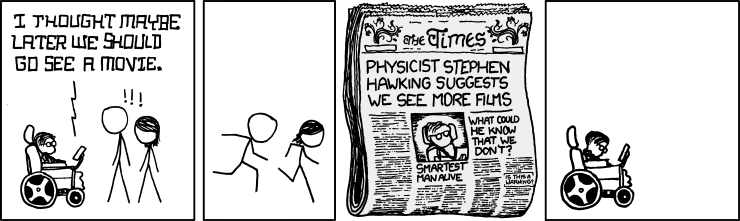
(OOOOOOPS - click on it to see the whole thing, while I work on my margins.)
This is from the very brilliant xkcd.com , source of one of my coveted items, a t-shirt with this

Readers who have been with me a while may recognize it from this post , which statcounter (which I check about once a year when I suddenly remember what the password is) tells me is my most popular page.
???????
Since no new peeps are commenting on that post, I can only guess that people are coming again & again to either also covet the shirt with this slogan (but why not go straight to the source?) OR, and this is an exciting possibility, to figure out what size I might like. Unisex Medium, people! Medium!!!!
Mwah.
In other funny science news, the Guardian explains how to write a science article for a news website:
This is a news website article about a scientific paper
In the standfirst I will make a fairly obvious pun about the subject matter before posing an inane question I have no intention of really answering: is this an important scientific finding?
You must go & read it. Really. You will plotz.
I was especially taken by the sub-headings.
This is a sub-heading that gives the impression I am about to add useful context.
None actually follows.
and
This subheading hints at controversy with a curt phrase and a question mark?
This paragraph will explain that while some scientists believe one thing to be true, other people believe another, different thing to be true.
In this paragraph I will provide balance with a quote from another scientist in the field. Since I picked their name at random from a Google search, and since the research probably hasn't even been published yet for them to see it, their response to my e-mail will be bland and non-committal.
"The research is useful", they will say, "and gives us new information. However, we need more research before we can say if the conclusions are correct, so I would advise caution for now."
I promise you, you will read all science & health reporting with a fresh eye having seen this template on how it's done.
And do stick around & check out the comments on that Guardian article because many are just as hilarious as the article itself - right down to mentions of Dawkins & Godwin's law, as well as grammar & spelling trolls.
In definitely not funny science news,
The federal government engages in "unacceptable political interference" in the communication of government science, says the head of a group that represents both government press officers and science journalists.
"Openness is being held ransom to media messages that serve the government's political agenda," wrote Kathryn O'Hara, president of the Canadian Science Writers' Association, in an opinion published online Wednesday in the international scientific journal Nature.
Read more
This is a government run by a control freak.
This: Harperland: The Politics of Control
 is going on my TBR pile.
"Harperland" describes Harper as a political success story but paints a portrait of a ruthless strategist and control freak who insists that he approve every move of his government.
"This is the most massive centralization of power of any government in the history of Canada," Martin said.
First though, I have to unclench my teeth from reading this:
The Armageddon Factor: The Rise of Christian Nationalism in Canada

Oh dear. That's taken the entire post in a depressing direction, hasn't it?
Let's cheer ourselves up:
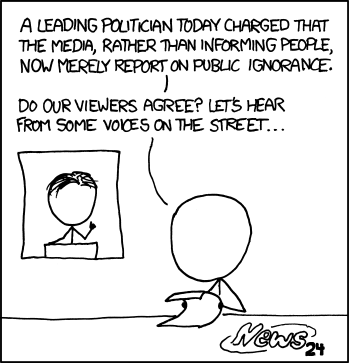
Er.........
Tuesday, May 11, 2010
Solar power!

I have these weird fantasies about going solar & off the grid. Yeah, exciting. I can hear you yawning already.
(Wanna hear another fantasy? Roo & I were once shooting the breeze about cars & what we'd get if we had buckets of money (we have one car, an 11 year old Toyota Sienna minivan, currently subject to a recall because our spare tire is apt to just unload itself. Don't drive behind me is all I can say.) I thought about it a while and said "a white Sienna HYBRID". Poor Roo staggered back in horror. One does not fantasize about minivans in his world apparently. And now that I think about it some more, I think I'd go with a Toyota Landcruiser. AND a hybrid Sienna. 'Cause if I'm fantasizing, I can have two cars, right?!)
So anyway, enough about me, because this is a post about Hugo and his new solar kit and our baby steps to thumbing our noses at utility companies!
Hugo got this kit for his birthday. It's cool and it works!
It is a kit and what's inside the box is a bunch of pieces of plastic which you need to snap apart & then assemble the various models. There are six possibilities: the windmill (pictured), a revolving plane (which looks like the kind of amusement ride which makes me barf just thinking about it), an airboat, a plane, a car, and a PUPPY!
Perplexingly, Hugo has not yet made the puppy, which would have been my first choice. Hugo says all it does is wag its tail and vibrate, and as we have a real live specimen in the form of Darwin which does exactly that, Hugo was not as keen on making that model as the others.
The kit is available online from a variety of retailers, usually you can find it for under $20, and it's not Made in China! It's Made in Taiwan. :-)
Recommended for kids 10+ and Hugo gives it a thumbs up.
Hey, I even figured out the settings on the camera to make the blades look all whirly!
Tuesday, February 09, 2010
humane biology
Check out this site for alternatives to animal dissection for educational purposes.
The person behind Frogs are Cool lives in Vancouver and has been busy encouraging BC schools to develop written policies (& communicate them to the students) which permit opting out of dissection for biology courses.
The educational alternatives range from CD-Roms, to online dissections, to plastic models. Check out the site for lots of links - including many free resources such as Animal Learn .
Tuesday, October 13, 2009
Tuesday, August 18, 2009
Stand Back, I'm going to try Science!

This is from the xkcd store. And I covet the t-shirt with this. Just putting that out there. Also, do check out the actual xkcd comic site - which is brilliant, even if sometimes (often) I don't understand it.
This is the time of year when my doorstep is littered with delivery boxes and the package delivery folks & I strike up conversations since we see each other almost daily. Yes, it's curriculum shopping time!
Hugo especially is always extremely curious about what's inside the boxes and volunteers to open them for me. I wish I could say that there are loud ooooh's and aaaaaah's when the grammar and Latin books arrive. Because you know how homeschooled kids are supposed to embody the spirit of endless curiousity and enthusiasm about learning (my kids didn't read that memo). Mostly there's a 'Hm. I hope this is better than what we suffered through last year' kind of feeling.
But this one book fired Hugo right up.
I have some videos already of the project he's done from this book, and we've only had it for a week or so.
I'm still trying to figure out what we'll be doing for science this year. Because we're a pretty science oriented household anyway, I've been happy to mostly wing it up till now. But suddenly I really wanted a coherent planned curriculum, esp something for Chem, as it's right up Hugo's alley. Unfortunately, almost all the science curricula out there designed for homeschoolers are written by folks who are creationists (who come in two main flavours: young & old earth) or intelligent design proponents. In case you're wondering, the public school curricula, esp for chemistry, are heavily geared to use in a school with full lab and are apparently difficult to adapt to use at home; nevertheless I'm still considering ordering a set of Singapore Science because they're inexpensive and maybe I could figure out a way to make the labs work....
So I've spent the summer trying to find a packaged curriculum I could use & I have got nowhere, mostly because I refuse to support authors who are ID or creationist. Actually, old earth creationists I could live with. (well, not actually live with..... but I think I could use their books). Just when I thought I'd found something, I'd dig around, ask around on the boards & find out the author's leanings were not something I could support. So here I am in mid-August, and still no coherent curriculum.
In July, when I realized things were not going to go smoothly with this, I decided I'd better stock up on some basic books and if worst came to worst, I'd have to make up my own curriculum (in my vast spare time!)
So I ordered the book above, along with
All this, put together with my university Chem textbook and the biggest Thames & Kosmos kit I can get in Canada (which I think is the C1000; the others apparently contain 'dangerous chemicals' which won't be allowed over the border) should somehow gel together into an interesting year of study.
Sunday, July 12, 2009
I'm not scared of jiggly men thingies
Hugo got interested in Leonardo da Vinci's inventions recently (triggered I believe by a back issue of Calliope Magazine he was reading) so I dutifully put some books on hold at the library. (Note, this is one of the fundamental duties of a homeschooling parent: observe child intently for any sign of any interest in any subject, scour the library catalogues for that subject, and pick up at least 10, but preferably 20+ resources within a week of the first interest observation being made. If you wait longer than that, you run the real risk of the child having 'moved on'. If your child is less than 7 and/or ADD, you only have 48h to accomplish this task. You get bonus points if you manage to arrange a related craft/field trip/lego model within that same time period.)
I can heartily recommend this one:
We're still waiting for this one:
And when I was searching the catalogue, this popped up:
So I promptly requested it, it arrived next day, and Hugo barely made it through dinner that day in anticipation of the Leonardo video.
Mix one part history, with one brain from whoever came up with Junkyard Wars, and one part 'every reality tv type thing out there', and you get this.
All the melodrama.
Bob wants to use hickory. Steven wants to use oak. Will John be able to find a solution?
All the tension.
Jane isn't happy. The project is in jeopardy (cut to camera panning out of scene in a poignant moment, everyone looking sad and dejected).
The false sense of impending doom.
(narrator whispering) Meanwhile, the clock is ticking.
The terrible dilemmas.
(hushed narrator, in concerned tone) Bob is in a lumber yard. Looking at logs. Will there be a suitable log here?
And what is it all about? What matter of life and death is being determined here?
Um. Well, we have a couple groups of nerdy people who are building full scale projects of a) a giant crossbow and b) a glider, from drawings made by Leonardo. (Yes, that's how you refer to him. Leonardo. Not Da Vinci. Not Leonardo Da Vinci. Well, maybe just the first time. After that, it's just Leonardo. With an Italian accent please.
So apparently these teams have to use materials which would have been available in Leonardo's time and I think they're supposed to stick to the methods which would have been in common use at that time as well. Right away the crossbow team makes a decision to use laminated strips & I'm guessing they're using some fancy schmancy high tech glue so you can see how it goes.
You know, the show wasn't as bad as I'm probably making it sound but at one point, some director clued in that you could only show these wonderfully, plain, normal, nerdy, and very sweet but nevertheless rather dull people only so much on the screen before the viewer would change the channel. I mean, they're mostly sitting around thinking. And hammering. And looking at logs. With concerned faces.
So, off the director goes on a quick side trip of educational wonder to teach us all about how wonderful Leonardo is. And ooooooh, Leonardo was interested in anatomy. That will keep the audience glued! In fact, Leonardo was so interested in anatomy that he dissected corpses and made very detailed anatomical drawings of people! That's the ticket! Let's show the audience Leonardo hacking away at a really good imitation of a cadaver! Let's show him cutting up what looks remarkably like a human heart (& is therefore probably a pig heart). Yeah!!! That's the ticket!
The kids and I mostly missed the squelchy, blood spattery bits by hiding our faces.
Then it was finally over. But the boring teams were still doing quietly dull building so the director remembered:
For part of his anatomical studies, Leonardo sketched nudes!
Look! A modern art class sketching the human body. An old man standing in front of the classroom. He's nude. He's just standing there.
And from waist to knees he's pixelated.
Because you know how the jiggly man thingies might offend the viewer!
A cadaver with a partially dissected arm being hacked at by a bloody saw - bring it on!
But no naked flaccid penis! No naked old man buttocks!
No naughty bits at all, please. That would be too sensationalist.
Thanks PBS!
So. Which do you prefer? Dangly old man bits or squelchy dissection of a cadaver? Which (if either) would upset your kids more?
Friday, July 10, 2009
why I am not a tv journalist
I sound like an idiot on camera.
I've written about Snap Circuits before.
You know how things get more interesting again after they've been marinating in a closet for a few months? Well, these recently re-emerged when I was cleaning out a cupboard and presto, Hugo was building radios on the deck.
And I promptly said "Aha! I must document this for posterity. Let me ask you inane questions while I point a camera at you!"
I wouldn't be surprised if he spent the rest of the afternoon rigging the snap circuits to electrify my pillow and fry my hair as punishment for this video. (Hugo has a good dose of prankster within him. He carefully tucked very lifelike rubber mice all over my side of the bed one night. It's a testament to how tired I am that I lay down, felt some lumpy things all over and just lazily shoved them out of my way without even investigating what they were. If it doesn't bite me, doesn't insist on being fed in the middle of the night, and doesn't leak its diapers on me, I no longer give a damn about what is beside me in bed.)
Ok, back to snap circuits. They're fun, they're educational, they're not cheap pieces of crap. Get some.
And then you too can hook up a fan to a small engine and make it fly off. Like this:
Thursday, February 05, 2009
Me and Isaac Newton
This is fabulous.
It's a documentary directed by Michael Apted (Gorillas in the Mist) and focuses on seven modern day scientists: three women, four men, a wide variety of fields. Once you hear their accomplishments, you wonder why theirs are not household names. Why do we hear about sports stars and socialites but not these people?
The documentary is about what made them want to be scientists, what they have achieved, what do they see as their moral obligation. When I was reading the dvd blurb to the kids I said, "I think this might just be a bunch of people talking. We might not even see a lemur. Just because it mentions a lemur, don't get disappointed if there isn't one."
Because I sometimes forget that my kids are not 5 years old anymore.
Hugo said, "Mom, it sounds good. Just put it on."
So, it's not zooboomafu. But it is excellent.
What I liked most was that some of these scientists arrived in their careers a bit by accident, in roundabout ways. Some knew they wanted to be scientists from an early age but not all. That is a good thing to hear for kids who are not quite sure yet 'what they want to be' when they grow up.
I also think too often our kids lose the sense that one person can make a difference, and certainly as science and knowledge as a whole becomes increasingly complicated, a lot of the work is done collaboratively in teams. But still, on those teams are individuals, and their contributions are great.
I highly recommend this for the 10 and up crowd. Note that there is some emotionally moving content - there are scientists working on cancer treatments, and on water quality in the 3rd world. Dirty water kills 5000 children A DAY. These are real problems people are tackling, and while that's not the focus of the documentary, it is in there and it packs an emotional whallop.
It is an amazingly hopeful and inspiring film. Even if your kids have no interest in becoming scientists, I think they will appreciate it because the quest to live a good life is surely universal.
I suggest that you do not look up any of these scientists ahead of time. If you don't know them, just let them tell their own stories. The stories unfold quite amazingly throughout the film.
As a woman, a feminist, and mother of a girl, I was thrilled to see the women in this movie. Absolutely wonderful.
Really young viewers might find the beginning just a bit slow. The film does show the scientists in their own environments, and there is some beautiful cinematography but it is not done in the frantic modern fashion with abrupt scene and angle changes. It is more of a contemplative movie.
But there are lemurs.
And robots!
Tuesday, December 09, 2008
How does your garden grow.....

Is there anything more fun than planning next year's garden? Sorting through seed catalogues, flipping through gardening books, checking out the gardening tools at Lee Valley?
Never mind that I haven't actually finished putting the current garden to bed for the winter. Never mind the colossal landscaping project from hell which we need to tackle sooner or later but which is so overwhelming that we just keep ignoring it.
Never mind that it's just weeks before Christmas and I have three family dinners to organize and execute between Dec 12 and Dec 25.
Never mind all that. Now is the time to pull out gardening books and graph paper, and start planning.
Square Foot Gardening
Our library has the 3 volume VHS set of Mel Bartholomew's vintage show on Square Foot Gardening. I truly am a shallow person because the entire time I watched the videos of the show, I kept looking in awe at Mel's comb-over and beard combination (that's a youtube sample of the old show). I don't think I paid attention to anything he said about planting. Hugo however was entranced by the actual gardening; I know because he talked for several days about raised beds and how and where we should place them. I have to watch it again and try to actually pay attention to issues of soil and plant, and not sit in anticipation of what the breeze will do to the gardener's hair.
Luckily, I got the book too.
For more inspiration on growing a vegetable garden in small spaces, check out The Ornamental Kitchen Garden.
If you need motivation, watch
We watched this last week and I got a kick observing my kids' reactions to it. Amelia, bless her righteously indignant soul, was ready to protest, march on the seat of government, buy organic, grow our own, and scream obscenities in the impassive face of multinational greedy corporations. I might be projecting a bit. She is, nevertheless, very much MY child. I know I can count on her to be right beside me if I ever decide to chain myself to something on the 6 o'clock news.
Hugo's first instinct is to work out how to make this technology safe. Couldn't some safe guard be implemented? Can't we develop some new invention which will allow us to reap the benefits and minimize the risks? Right away, his brain is running off on some new engineering track, tinkering with the innovations with a refreshing optimism and enthusiasm.
Right there, in my living room, it's a battle between neo-Luddism and progress.

Back to my garden. I'm a bit chagrined to admit that we have this wondrous thing called a greenhouse. So far, it's been nothing more than somewhere to dump tools, and a cool place for the kids to play with soil, seeds and water, esp. when it's raining outside. Next year, I plan to actually use this greenhouse to grow things. Anyone want to recommend a book on how to use a greenhouse on the West Coast? It's south facing, but it's not terribly warm, except in the summer when it becomes stiflingly hot. It would keep the rain off tomatoes so it would be good for avoiding blight, but what else can I use the greenhouse for?
For more inspiration, check out the old and funny British sitcom about a couple who decide to become 'self sufficient' while living in their suburban home:
They had pigs, and a goat called Geraldine, and a rooster named Lenin. If I ever have a rooster, I will call him Lenin.
I actually looked into backyard chickens in our municipality, and I've discovered that the bylaws bafflingly lump all animals together, and put on a limit of three. So, on a residential lot, I can have three pet hamsters. Or three pet dogs. Or three pet chickens. Or one hamster, one dog, and one chicken. Just so long as they're pets, living inside my home, that would be ok.
Is it just me, or is this slightly insane?
Apparently there is a growing movement to promote backyard chickens and to amend municipal bylaws to allow for small coops. If you're interested in backyard chickens, do check out the Backyard Chickens website and subscribe to their newsletter.

So, what about you? Any plans for next year's gardens? What seed catalogues do you like? Are you saving your own seeds? Growing heritage plants? Self sufficient? And do you want to talk me into chickens?
(all photos are from Hugo's 2008 garden)
Friday, November 28, 2008
Bird Sanctuary
On Wednesday, we went with friends to the George C Reifel Migratory Bird Sanctuary. We've had a membership there for years. I used to take the kids when they were little, bring a stroller and a snack and just wander around. It's a great place for littles to walk because it's flat. There are also numerous benches on the trails so you can take a break, have a small snack (there are no garbage cans and you need to bring out all your litter), listen to bird song, consult your field guide, and practice focusing your binoculars.
The ducks are friendly and will feed from your hand.
The three kids who were with us that day are "big kids", ranging from 10 to almost 14, but they all got a huge kick from getting black-capped chickadees to feed from their hands. You do have to be very still and patient but for good seed, they will come.
Tip: if you want to make your toddler or young child happy, and save money, bring your own seed from home. The sanctuary sells tiny packets of seed at $.50 and while I don't begrudge them the money, and while I also understand that over feeding certain species creates ecological difficulties, few things beat the thrill of kids getting to feed the birds. Buy proper seed please - either a blend or black oil sunflower seeds. Do not feed the birds bread or other scraps from your lunch! When the kids were little, for a 2 hour outing, I used bring about 4-6 cups of seed for 2 kids. Put an adult in charge of a big container of seed & just give the kids small containers which you refill regularly. This way, if they trip and spill seed, you won't have to fight off a hundred hungry mallards and Canada geese to frantically pick it back up.
Also note that it's not permitted to feed the birds by the parking lot and near the entrance. Wait until you're well into the sanctuary grounds to start the feeding frenzy.
My other tip for fall-spring visits is to bring extra clothes. It's by the ocean, so often the perimeter trails can be quite windy and cool if you're not dressed for the weather. In the summer, it can be quite hot and since large chunks of the trails are through exposed marshy grasslands, you'll want a good sunhat and sunscreen.
The last tip is to bring a camera.
Ahem.
I forgot mine on Wednesday.
We saw three of these:
 (Wikimedia Commons: http://en.wikipedia.org/wiki/Image:Nycticorax-nycticorax.jpg)
Well, the reality is I wouldn't have got a shot like this anyway. Not being serious birders, we don't have fancy cameras or scopes. Not to mention that we didn't know what this was at first and had to ask the serious folks, with tripods and gigantic cameras and vests with lots of pockets.
It's a black-crowned night heron. It's supposed to be mostly nocturnal. One of the ones we saw was sleeping with its head tucked in a wing, but another one was preening.
The snow geese have arrived but they were out at the far beaches. We could hear them from one of the bird blinds but all we could see was swirling patches of white, way out by the ocean.